
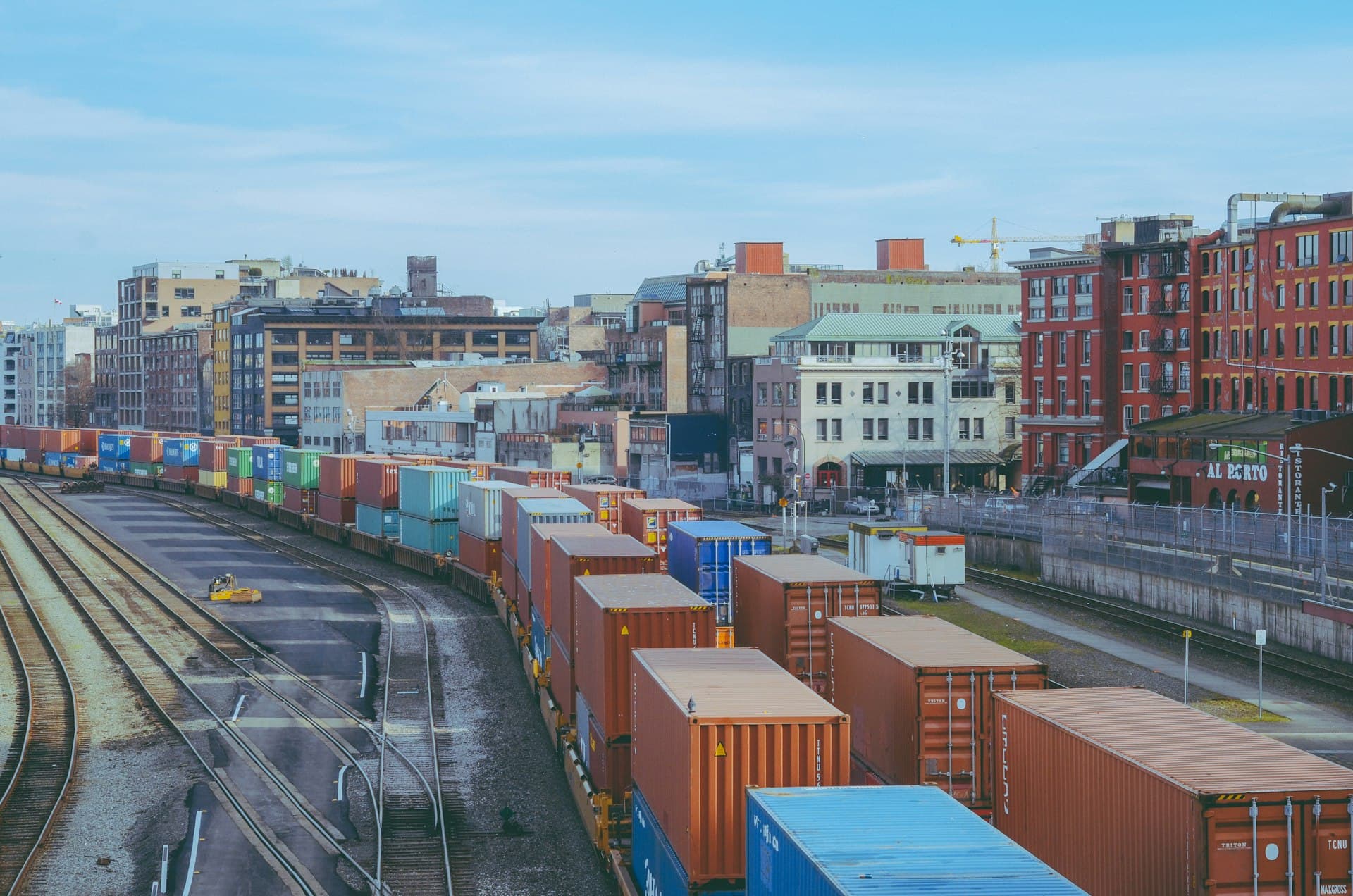
Photo by Matt Hanns Schroeter on Unsplash
Insights
Container Shipping from Asia to the U.S. Midwest: Routes, Timing, Reality
If you're a Midwest importer bringing containers from Asia, you've probably noticed that "just ship it to the U.S." hides a lot of decisions. The container that lands in Los Angeles isn't anywhere near Minneapolis or Chicago yet. Here's how the routing actually works, what affects your transit time and cost, and where the operational landmines are.
Two main routes — pick the right one for your shipment
There are two viable routings for a container moving from Asia to the U.S. Midwest:
West Coast port + intermodal rail. Containers arrive at Los Angeles or Long Beach (the most common), Oakland, or Seattle/Tacoma. They're transferred to a railcar at the on-dock or near-dock rail yard, then railed inland to Chicago — BNSF or Union Pacific — where they're either delivered locally or trucked to a final destination further out.
- Typical port-to-Chicago transit: 4-7 days by rail
- Total Asia-to-Midwest transit: ~18-25 days from Shanghai
- Cost: generally the lowest per-container option for Midwest delivery
East Coast or Gulf port + truck or rail. Containers transit the Panama Canal or Suez/transatlantic to ports like New York/New Jersey, Norfolk, Savannah, Houston, or New Orleans. From there, they're trucked or railed inland.
- Typical port-to-Midwest transit: 2-5 days by truck, 4-6 days by rail
- Total Asia-to-Midwest transit: ~30-40 days via Panama Canal
- Cost: typically higher than West Coast routing, but more reliable when West Coast ports are congested
Why each route matters
The obvious choice for an Asian shipment to the Midwest is West Coast + rail — it's the shortest physical path. But the obvious choice isn't always the best one. Several factors push shippers toward East/Gulf routing:
Port congestion. During peak season (August-October), West Coast ports get backed up. Containers sit on terminals for days, vessel anchorage queues build, rail capacity tightens. East Coast and Gulf routings, while slower in transit, can be more predictable.
Rail capacity. BNSF and Union Pacific control intermodal rail to Chicago. When their capacity is stretched, even containers that land smoothly at LA/LB sit in stack queues for days waiting for rail.
Equipment availability. Chassis (the trailers containers ride on for trucking) are routinely in short supply at major ports. Less so at smaller East Coast ports.
Bonded warehouse strategies. Some importers use East Coast bonded warehouses to defer customs clearance until later in the supply chain, optimizing duty timing. This shifts the routing math.
Carrier service patterns. Specific carriers run specific routes. If your preferred carrier services Savannah but not Long Beach, that's a factor.
Transit time realities
The headline transit time is rarely the full story. Here's what actually fills out the timeline:
- Origin: 1-3 days between booking confirmation and cargo physically loading at the origin port
- Ocean transit: 12-18 days from Asia (e.g., Shanghai) to LA/Long Beach
- Port arrival to rail departure: 2-7 days — vessel berthing, container offload, rail transfer. This is the most volatile leg.
- Rail transit to Chicago: 4-7 days, pretty consistent
- Final delivery: 1-2 days by truck from Chicago rail yard to Minneapolis, Detroit, St. Louis
That's a 20-37 day total range for what advertisements often pitch as a "21-day port-to-port" service. Build buffer.
Timing landmines
Several recurring events should be on your calendar if you're planning Asia-Midwest shipments:
Lunar New Year (January-February). Manufacturing in China shuts down for 2-3 weeks. Cargo built up before the holiday floods ports for the 2 weeks leading up to it, then dries up for 3-4 weeks after. Bookings made for the post-LNY period are particularly competitive.
Golden Week (October 1-7). Similar dynamic but smaller. Manufacturing reduces output, port congestion shifts.
Peak season (August-October). Retailers stocking for the holiday shopping season pull massive volumes across the Pacific. Rates climb, capacity tightens, transit times stretch.
Hurricane season (June-November). Gulf and East Coast ports periodically close due to tropical weather. Brief but disruptive.
Late Q4 / early Q1. Things naturally slow down in late December and January as factories prepare for LNY, but ports also clear out — sometimes a good window for shipments that can move on the calmer waters.
Customs clearance — where it happens matters
You can clear customs at any U.S. port of entry, not just where the vessel arrives. This opens up some strategic flexibility:
- Clear at the port of arrival (e.g., LA) — fastest if you have a customs broker there
- In-bond shipment to Chicago (or another interior port) — clear customs there, sometimes preferred for inland customers
- In-bond to a foreign trade zone (FTZ) — defers duty payment until cargo leaves the FTZ
The right choice depends on your customs broker's footprint, your cash flow situation, and whether you're doing further processing in an FTZ. Talk to your broker about the optimal entry point — it can save days and meaningful duty deferral.
Why an NVOCC matters for this routing
For Asia-Midwest shipments, working through an NVOCC instead of booking direct with an ocean carrier offers a few practical advantages:
- Multiple carrier relationships. An NVOCC books with whichever carrier has the best capacity that week, rather than tying you to one carrier's service schedule.
- Bundled inland coordination. The NVOCC handles port-to-Chicago rail and Chicago-to-final-destination drayage as part of the same engagement.
- Single point of contact. When the vessel is delayed or the rail yard is backed up, you call one person who can chase the carrier, the terminal, AND the rail line.
- LCL consolidation. If you're not shipping full containers, an NVOCC consolidates LCL into shared containers — direct carriers don't.
For a fuller explanation of what NVOCCs actually do, see our piece on what an NVOCC is.
The Conveyco take
We're an NVOCC based in Burnsville, Minnesota, which means we book Asia-Midwest shipments routinely — it's our home turf. Our customers ship into Minneapolis, Chicago, Detroit, Milwaukee, Kansas City, Cleveland, St. Louis. We've got specific routings dialed in for each.
If you're considering Asia-Midwest freight and want to talk through routing options for your specific origin, destination, and timing, request a quote or reach us at Conveyco-Concierge@theconveyco.com. We're happy to talk through routing tradeoffs before any commitment.